V3 White Paper
VoiceXML Forum Technical Council
Rob Marchand, Editor
Overview
In the spring of 2004, the VoiceXML
Forum conducted a survey of Forum members to collect feedback on the current
and future direction of VoiceXML and related technologies.
One of the goals of this research
was to provide the Voice Browser Working Group with additional industry direction
regarding the evolution of VoiceXML, V3, and other standards in development
by the VBWG.
Results
A summary of the results is as follows:
- Thirty forum members responded;
- Respondents included a mix of
platform vendors, application developers, hosting providers, tools vendors,
and training providers;
- The majority of respondents are
not involved with SALT at this time;
- All are using or plan to use VoiceXML;
- The value of VoiceXML as a standard
is clear - as is the importance of its evolution.
A number of questions relating to
VoiceXML 2.0, V3 and the evolution of VoiceXML were posed to the respondents.
Results related to V3, are shown in Appendix A.
The VoiceXML Forum Technical Council
believes that the key messages to the Voice Browser Working Group are as summarized
below.
Most Important V3 Capabilities
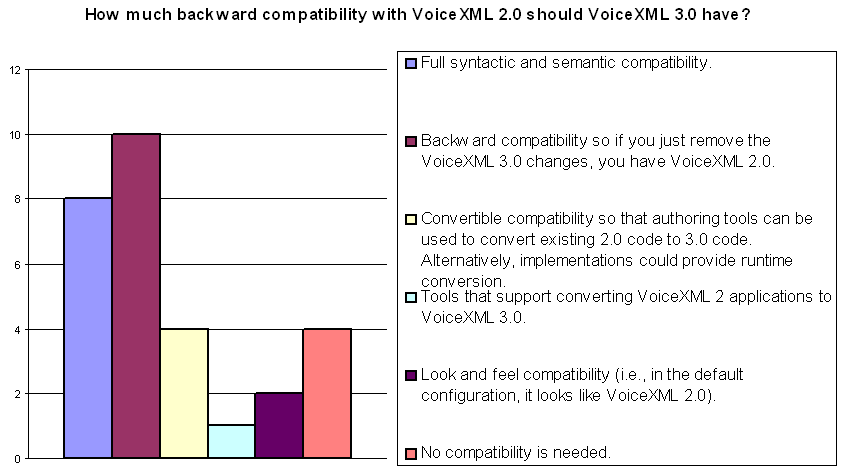
- Some level of compatibility
with VoiceXML 2.0 is important - Respondents (25 out of 30) are highly
interested in being able to have a clear migration path from VoiceXML 2.0
to V3 - whether by backwards compatibility, a VoiceXML 2.0 profile, or translation,
this is viewed as useful.
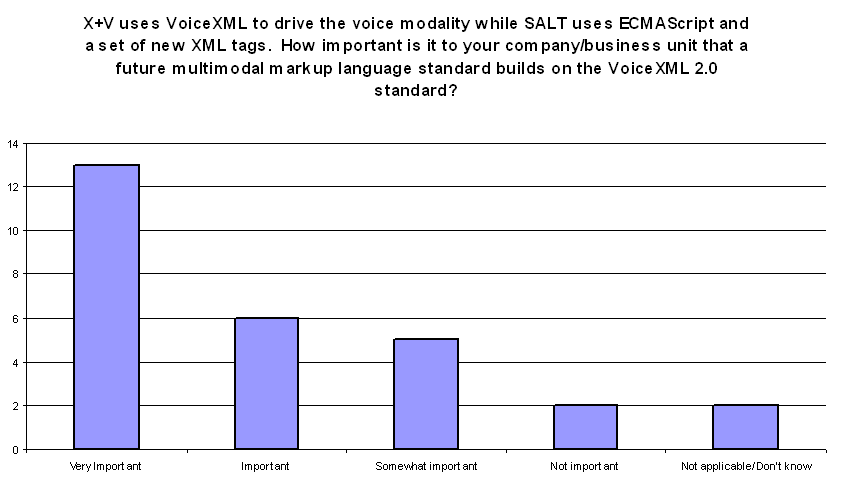
- Most respondents want multimodal
markup to build on VoiceXML - Respondents (24 out of 30) are quite interested
in leveraging their existing skills, VoiceXML capabilities, and the market
acceptance of VoiceXML, in being able to develop a multimodal markup language
based on VoiceXML, such as X+V.
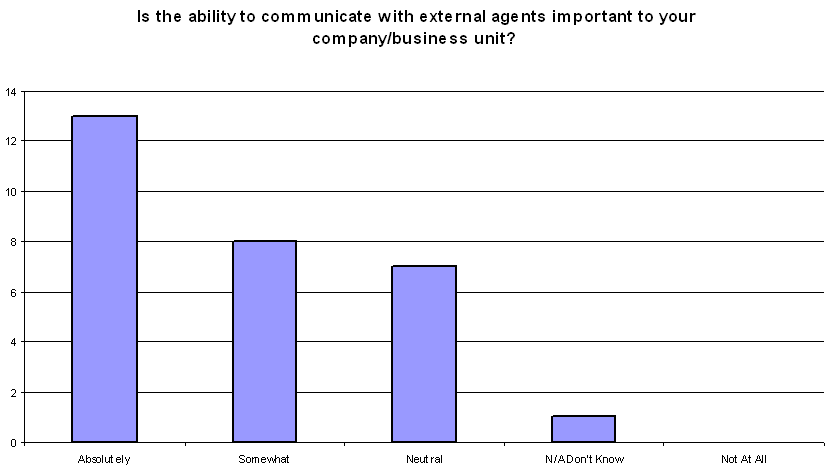
- The ability to communicate
between VoiceXML and external entities is important - This capability
has particular application in multimodal environments, and allows VoiceXML
to communicate outside of the HTTP request/response model. Respondents (21
out of 30) indicated this ability was at least somewhat important.
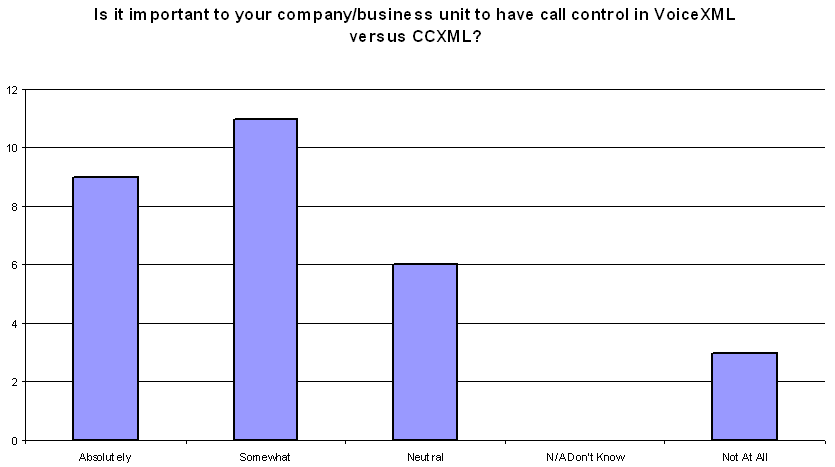
- Support for call control within
VoiceXML itself is important - CCXML is viewed as an important standard
- however, 20 out of 30 respondents indicated that call control capability
within VoiceXML itself remains important.
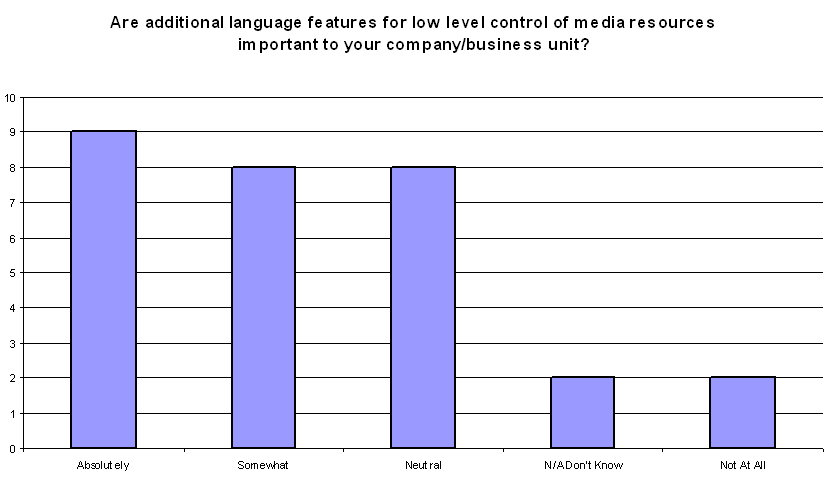
- Additional control over low-level
media is desirable -Respondents (17 out of 30) wished to have a higher
level of control over low-level media resources. These are available as extensions
to VoiceXML 2.0 now in some cases, and a standardized mechanism for this is
desirable.
Important V3 Capabilities
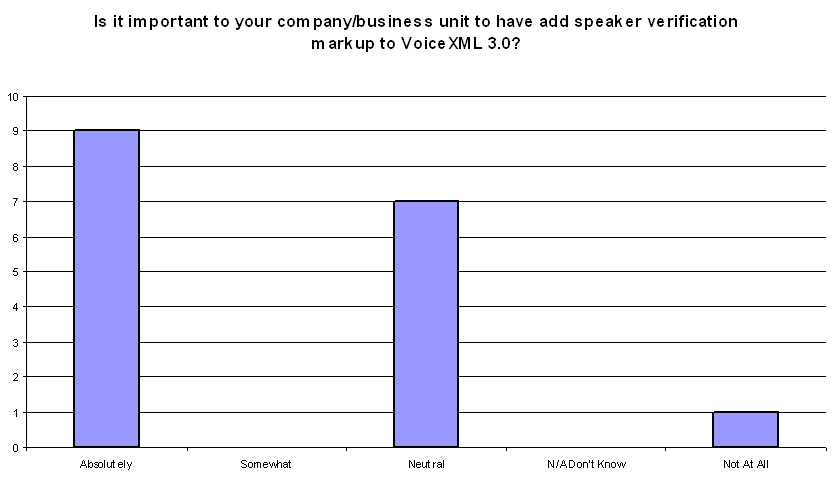
- V3 should include support for
Speaker Verification - Speaker Verification is viewed as a key requirement
for V3 by 9 out of 30 respondents.
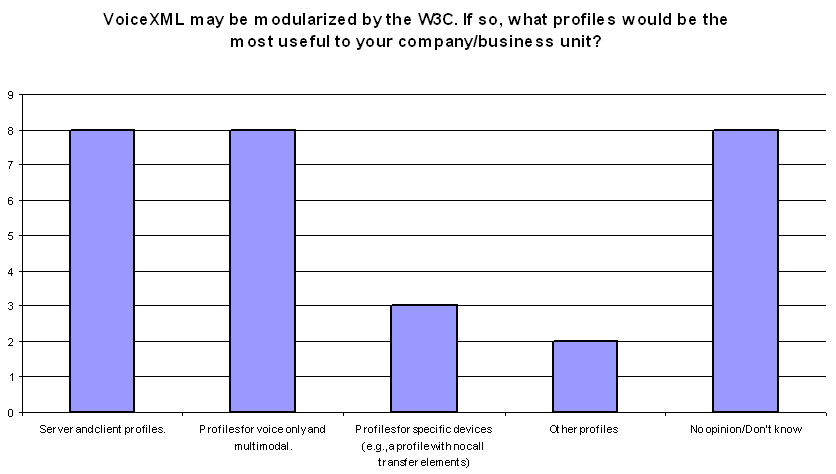
- Although respondents are interested
in modularization of VoiceXML, it is not yet clear which profiles should be
defined - This is perhaps to be expected, as multimodal architectures
continue to evolve (8 with no opinion, and others split among various profile
options - client/server and voice/multimodal with 8 each).
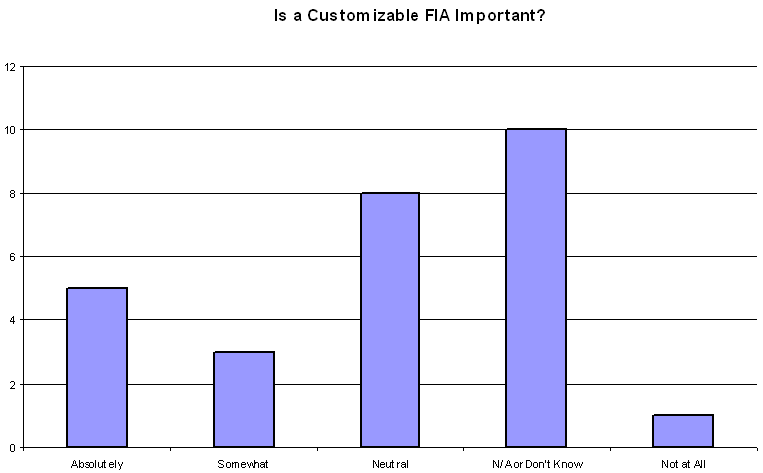
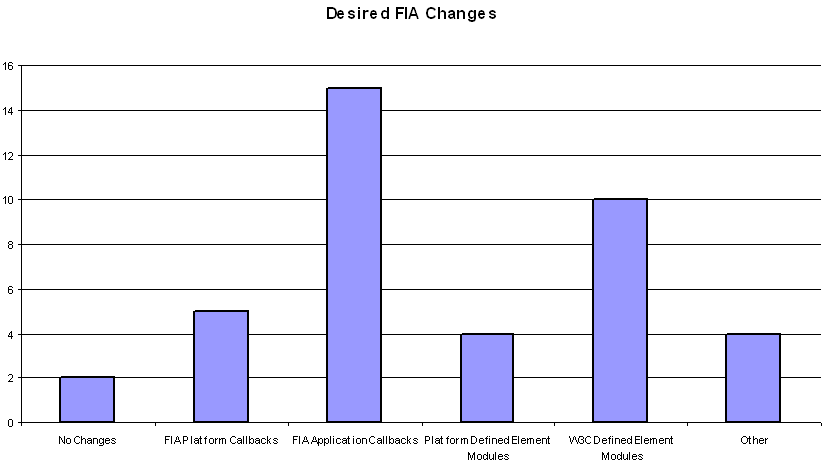
- Additional control over the
FIA is desirable -Respondents (8 out of 30, with 10 N/A or don't know)
indicated a desire to be able to exercise more control over the FIA, either
via completely custom (pluggable) FIAs, or via a callback mechanism.
Summary
The VoiceXML Forum Technical Council
has submitted these results to the VBWG as part of our mandate to provide industry-based
technical input to the VoiceXML Forum, and to the W3C. It seems clear that VoiceXML
is meeting many market needs today, but can continue to widen its appeal to
industry. In addition, VoiceXML and related languages can act as valuable inputs
to the V3 efforts.
For additional information regarding
the VoiceXML Forum survey, contact the VoiceXML Forum Technical Council Liaison
to the W3C, Ken Rehor (krehor@vocalocity.net).
Appendix A
Copyright © 2004 VoiceXML
Forum. All rights reserved.
The VoiceXML Forum is a program of the IEEE
Industry Standards and Technology Organization (IEEE-ISTO)